


IC (I see)
Infection Prediction in Cirrhosis
A Novel Approach to Assessing Humoral Immune Function
Assessing Humoral Immune Function to Identify Patients at Risk
The Challenge
Patients with liver cirrhosis are particularly vulnerable to severe bacterial infections due to impaired immune function. These infections can lead to serious complications, prolonged hospitalization, and increased mortality.
Although early identification of patients at increased risk could enable preventive interventions and improved clinical management, there are currently no prediction tools for severe infections implemented in routine clinical care.
Our Innovation
IC (I see) is an innovative approach for assessing the functional state of the humoral immune system and identifying patients who may be at increased risk of severe infections.
The technology builds on the same biological principle as AGRA, CBmed’s patented method for infection risk prediction, but uses a different measurement approach. IC was developed to overcome practical limitations associated with repeated optical density measurements, regression modeling, and the need for specialized laboratory equipment or personnel.
Solution
IC uses the growth response of a model bacterium in the presence of patient serum or plasma to provide a functional assessment of the humoral immune system.
Unlike AGRA, IC does not require continuous monitoring of bacterial growth, individually fitted regression models, or specialized data analysis. Instead, the assay uses a simplified visual readout to classify humoral immune function as intact, indeterminate, or impaired.
This easy-to-interpret approach is designed to support broader and more decentralized use, including potential application in clinical settings without access to specialized biomedical laboratory infrastructure.
Application
Liver Transplantation
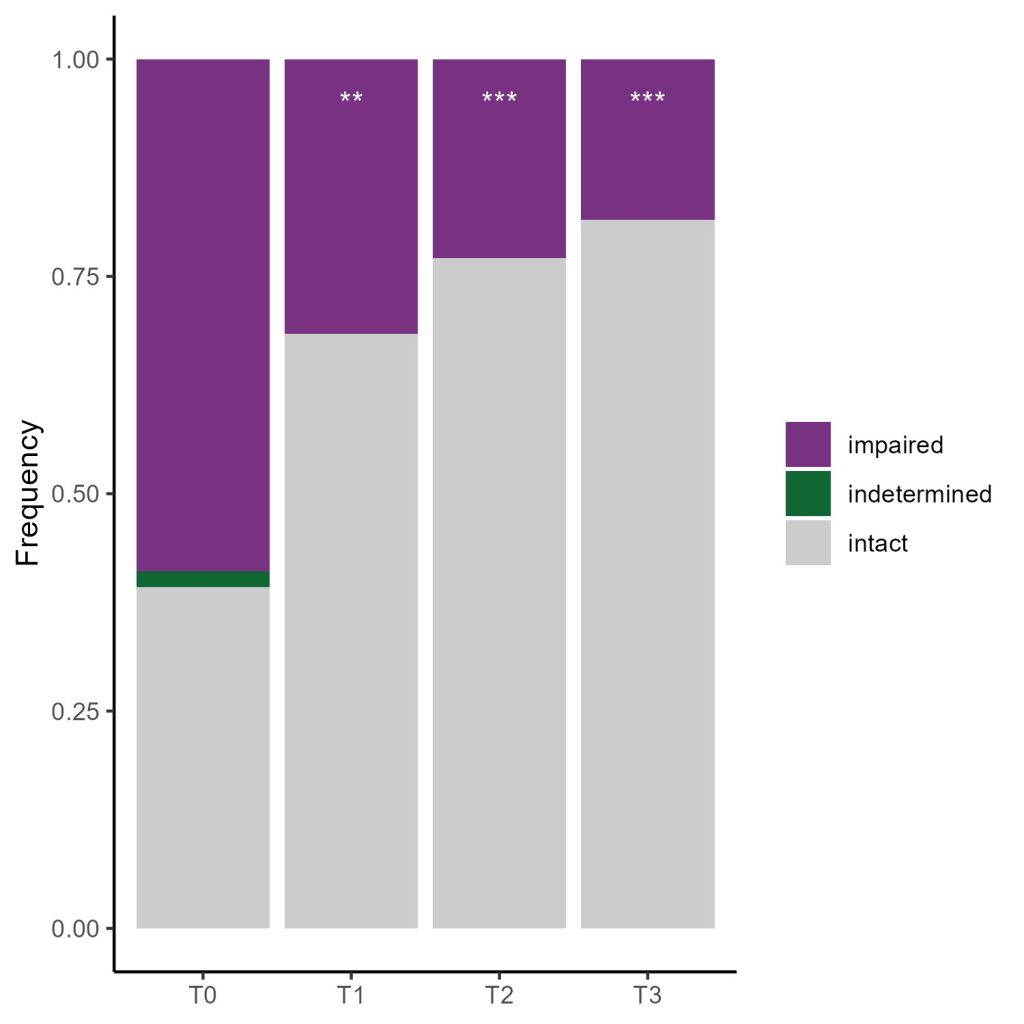
In a cohort of 55 patients undergoing liver transplantation (LTX), IC showed a significant improvement in the state of the humoral immune system. As shown in the figure, IC measurements before (T0) and after liver transplantation (T1-T3) demonstrate a significant improvement in humoral immune function following transplantation. Improvements were already evident within two days after liver transplantation (T1).
Potential Impact
IC could provide healthcare professionals with an accessible tool for assessing humoral immune function and identifying patients with potentially increased susceptibility to severe infections.
In addition to infection risk assessment, IC may support the monitoring of immune function following clinical interventions such as liver transplantation. Although initially investigated in patients with chronic liver disease, the approach may also have potential in other conditions associated with impaired immune function.
Key Benefits
- Functional assessment of the humoral immune system
- Simple and easy-to-interpret visual readout
- Classification of immune function as intact, indeterminate, or impaired
- No continuous optical monitoring or regression modeling required
- Reduced reliance on specialized equipment and analytical software
- Potential use for infection risk stratification and longitudinal monitoring
- Designed to support broader and decentralized application